The Mid-Level Talent Vacuum: Why Vietnam's Leadership Pipeline Is Breaking Down
The Mid-Level Talent Vacuum: Why Vietnam's Leadership Pipeline Is Breaking Down
By Valerie Ong, Regional Marketing Manager, Reeracoen group
Vietnam produces graduates. It does not yet reliably produce the next layer of leadership above them. This is the Mid-Level Talent Vacuum - and it is one of the most structurally significant findings from the Vietnam Employer Hiring Study 2026.
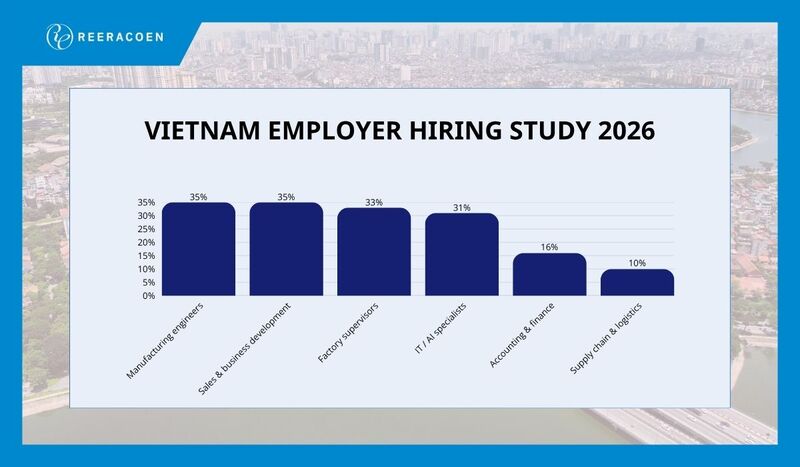
39% of employers cite a shortage of mid-level managers as a top hiring challenge. The hardest roles to fill are not entry-level positions. They are experienced, specialist hires: manufacturing engineers (35%), sales and business development professionals (35%), factory supervisors (33%), and IT/AI specialists (31%).
Understanding the Vacuum
The Mid-Level Talent Vacuum is not a new problem in Vietnam. But it is becoming more acute as business growth accelerates and demand for experienced professionals outpaces supply.
Vietnam's education system has made strong progress at the entry level. But there is a structural gap between producing capable junior talent and developing that talent into effective managers, supervisors and commercial leaders. The gap exists for several reasons:
-
Insufficient investment in structured leadership development - many companies rely on on-the-job learning without formal programmes
-
High job-hopping rates among junior talent - employees change roles before accumulating the depth of experience that makes mid-level candidates compelling
-
Intense competition for experienced professionals - FDI companies compete aggressively for the same limited pool of mid-level talent
-
Salary inflation at the mid-level - as demand exceeds supply, compensation expectations for experienced professionals have risen sharply
Why Mid-Level Talent Matters More Than Senior Talent
Many organisations focus their talent strategy on senior leadership hires. But mid-level professionals are the layer that actually executes strategy. They are the manufacturing engineers who keep production lines running, the sales managers who build client relationships, the factory supervisors who translate operational plans into daily results.
When this layer is thin, the consequences cascade upward. Senior leaders become operationally over-stretched. Junior employees lack experienced mentors. Projects stall. Growth targets slip.
Filling mid-level vacancies from the external market is both expensive and slow. Building the pipeline internally is significantly more cost-effective - and more sustainable.
Three Strategies to Address the Vacuum
1. Identify high-potential junior talent now
The most effective way to close the mid-level gap is to begin building the pipeline before you need it. Identify your highest-potential junior employees - those who show leadership behaviours, commercial instinct and strong technical foundations - and begin investing in their development now.
An 18-24 month structured development programme is sufficient to meaningfully accelerate readiness for mid-level roles. Companies that start this process in 2026 will have stronger internal pipelines by 2027-2028 - when the mid-level shortage is projected to intensify further.
2. Create visible promotion frameworks
20% of employers cite career progression expectations as a top retention risk - meaning talented people are leaving because they cannot see a clear path upward. Transparent, structured promotion frameworks - where criteria for advancement are explicit and consistently applied - are one of the most effective retention tools available and cost very little to implement.
3. Partner with specialist recruiters for external mid-level hires
Where internal development cannot fill the gap quickly enough, specialist recruitment partners with deep networks in your sector can significantly reduce time-to-hire for mid-level roles. The key is precision briefing: providing your recruitment partner with detailed role requirements, cultural context, and realistic timelines - not a generic job description.
Based on Reeracoen's experience placing mid-to-senior professionals across Vietnam's manufacturing, IT, sales and finance sectors, the most successful mid-level searches are those where the employer invests time upfront in briefing, moves quickly on strong candidates, and has a clear compensation benchmark aligned to the current market.
The Longer View
The Mid-Level Talent Vacuum will not resolve quickly. The organisations that will navigate this most successfully are those that treat mid-level talent development as a strategic investment, not an HR overhead.
In 2026, that distinction is becoming a meaningful competitive differentiator.
|
Looking for Experienced Mid-Level Talent in Vietnam? |
Frequently Asked Questions
What is the Mid-Level Talent Vacuum in Vietnam?
The structural shortage of experienced, specialist professionals in Vietnam's labour market. While the country produces strong junior talent, the pipeline of capable managers, supervisors and technical specialists is significantly undersupplied relative to demand.
Which mid-level roles are hardest to fill in Vietnam in 2026?
Manufacturing engineers (35%), sales and business development professionals (35%), factory supervisors and production leaders (33%), and IT/AI specialists (31%). These roles require meaningful work experience and specialist capability that cannot be quickly developed from entry level.
Why is it so difficult to find mid-level managers in Vietnam?
Insufficient investment in formal leadership development, high job-hopping rates that limit depth of experience accumulation, intense competition among FDI companies for the same talent pool, and salary inflation pricing some employers out of the market for experienced professionals.
How long does it take to build a mid-level talent pipeline internally?
Based on Reeracoen's experience advising employers across Vietnam, an 18-24 month structured development programme is typically sufficient to meaningfully accelerate the readiness of high-potential junior employees for mid-level roles.
What can employers do right now to address mid-level talent shortages?
Identify high-potential junior employees and begin structured development programmes, create transparent promotion frameworks, conduct salary benchmarking for experienced professionals, and partner with specialist recruitment agencies with deep networks in your sector.
Related Articles
You may also find these useful:
-
Vietnam Employers Are Hiring More in 2026 - But Struggling to Compete for the Talent They Need
-
Vietnam Hiring Outlook 2026: Skills, Sectors & Salary Signals Employers Must Know
About the Author
|
Valerie Ong Regional Marketing Manager, Reeracoen Group Valerie leads content and market insights for Reeracoen across Southeast Asia. She works closely with Reeracoen's specialist recruitment consultants to translate hiring data, salary benchmarks and labour market trends into practical guidance for employers and professionals. Her work draws on Reeracoen's proprietary research including the annual Salary Guide, Hiring Pulse, and Hiring Manager Survey. Language note: This article is published in English. Reeracoen also publishes selected content in Vietnamese and Japanese for our professional community. |
References
1. Reeracoen Vietnam. (2026). Vietnam Employer Hiring Study 2026.
2. Reeracoen Vietnam. (2026). Vietnam Employers Are Hiring More in 2026 - But Struggling to Compete for the Talent They Need.
3. Reeracoen Vietnam. (2025). Succession Planning in 2025: Building a Future-Ready Workforce in Vietnam.

Disclaimer: The information provided in our blog articles is intended for general informational purposes only. It is not a substitute for professional advice and should not be relied upon as such. While we strive to provide accurate and up-to-date information, the ever-evolving nature of certain topics may result in content becoming outdated or inaccurate over time. Therefore, we recommend consulting with qualified professionals or experts in the respective fields for specific advice or guidance. Any actions taken based on the information contained in our blog articles are solely at the reader's discretion and risk. We do not assume any responsibility or liability for any loss, damage, or adverse consequences incurred as a result of such actions. We may occasionally provide links to external websites or resources for further information or reference. These links are provided for convenience and do not imply endorsement or responsibility for the content or accuracy of these external sources. Our blog articles may also include personal opinions, views, or interpretations of the authors, which do not necessarily reflect the views of our organisation as a whole. We encourage readers to verify the accuracy and relevance of information presented in our blog articles and to seek professional advice when needed. Your use of this website and its content constitutes acceptance of this disclaimer.
Related Post
 “Tôi luôn ở đây vì bạn”: Khi Reeracoen Way không chỉ còn là lời nóiGeneral
“Tôi luôn ở đây vì bạn”: Khi Reeracoen Way không chỉ còn là lời nói Tại một ngôi làng dành cho trẻ em ở Philippines, cách xa những văn phòng...
- “I’m Here for You”: When the Reeracoen Way Became More Than WordsGeneral
“I’m Here for You”: When the Reeracoen Way Became More Than Words In a children’s village in the Philippines, far from Reeracoen’s offices across...
 3 Thách thức Tuyển Dụng Nhân Sự Lớn Doanh nghiệp Việt Nam Phải Đối Mặt trong 2026General
3 Thách thức Tuyển Dụng Nhân Sự Lớn Doanh nghiệp Việt Nam Phải Đối Mặt trong 2026 KẾT QUẢ CHÍNH — Báo cáo Xu hướng và Kỳ vọng Người Lao động Việt...
- The Triple Constraint: Why Vietnam Employers Are Losing the Talent War on Three Simultaneous Fronts in 2026General
The Triple Constraint: Why Vietnam Employers Are Losing the Talent War on Three Simultaneous Fronts in 2026 KEY FINDINGS — Vietnam Worker...