The Efficiency Paradox: Why Vietnam's Hiring Growth Is Not Matching Budget Growth in 2026
The Efficiency Paradox: Why Vietnam's Hiring Growth Is Not Matching Budget Growth in 2026
By Valerie Ong, Regional Marketing Manager, Reeracoen Group
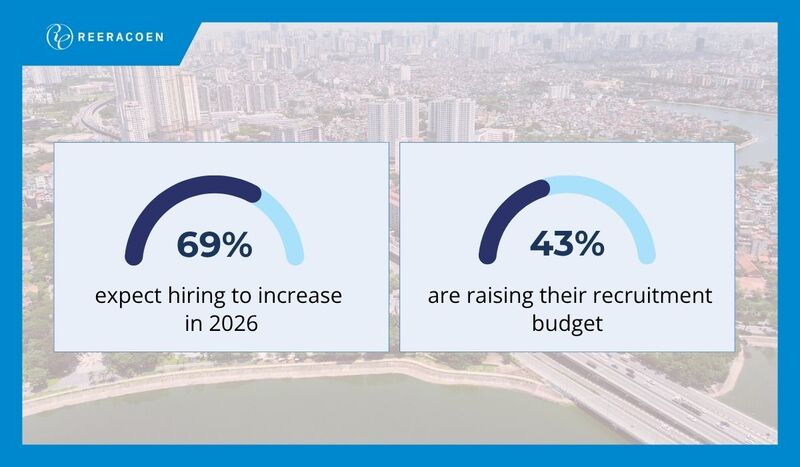
69% of employers in Vietnam plan to hire more in 2026. Only 43% are increasing their recruitment budgets. This gap - hiring ambition running ahead of hiring resource - is one of the most consequential findings from the Vietnam Employer Hiring Study 2026, and it has a name: the Efficiency Paradox.
If you are an HR leader or hiring manager in Vietnam, this paradox is not abstract. It is the reality you navigate every time you open a new vacancy.
What the Data Shows
The Vietnam Employer Hiring Study 2026, conducted by Reeracoen Vietnam in March 2026 based on responses from 51 employers across key industries, reveals a striking mismatch between hiring intent and investment:
-
69% of employers expect to increase hiring activity in 2026
-
Only 43% are increasing their recruitment budgets
-
47% are holding budgets flat
-
10% are reducing recruitment budgets
At the same time, 84% of employers expect new hire salaries to rise. Companies are being asked to hire more people, at higher salary levels, with the same or less resource. That is the paradox in full.
Why This Matters More Than It Appears
When hiring demand rises faster than recruitment resource, the typical outcomes are:
-
Longer time-to-hire - vacancies stay open longer, costing productivity and revenue
-
Lower shortlist quality - less time and resource means less rigorous sourcing
-
Higher offer rejection rates - candidates receive competing offers while decisions are delayed
-
Greater reliance on reactive hiring - planning gives way to firefighting
Each outcome compounds the next. A longer hiring process loses candidates to faster-moving competitors. Lower shortlist quality leads to more interview rounds. More rounds mean more time lost. In a market where 86% of employers are already struggling with rising salary expectations, adding process inefficiency makes every hire harder and more expensive.
Three Ways to Close the Gap
1. Audit your hiring process for bottlenecks now
Map your current time-to-hire from vacancy approval to offer acceptance. Identify where delays occur - approval chains, interview scheduling, assessment rounds - and eliminate or compress the steps that add friction without adding value.
Based on Reeracoen's experience working with employers across Vietnam, the most common bottlenecks are slow internal approval processes and multi-stage interview structures designed for slower markets. In 2026, both need to be reviewed.
2. Shift from volume to precision in sourcing
More CVs is not the answer to a budget-constrained hiring environment. Fewer, better-matched candidates delivered faster is. This requires a fundamental shift in how you brief your recruitment partners - from broad mandates to precise, detailed candidate profiles - and how you evaluate their performance.
80% of employers in the study want faster shortlisting of qualified candidates from their recruitment partners. The message is clear: quality and speed over volume.
3. Invest in partnerships, not transactions
Companies that treat recruitment transactionally - opening roles reactively, briefing multiple agencies with minimal context, moving slowly on strong candidates - will consistently underperform in a tight talent market.
Based on Reeracoen's experience advising employers across Vietnam, the employers who hire most effectively are those with deep, trust-based relationships with specialist recruitment partners who understand their business, their culture, and their candidate requirements.
Looking Ahead
The Efficiency Paradox will not resolve itself. As hiring ambition continues to outpace budget growth, the gap between companies that have optimised their talent acquisition and those that have not will widen.
In 2026, hiring efficiency is not a process improvement initiative. It is a strategic priority.
|
Ready to Hire More Efficiently in 2026? |
Frequently Asked Questions
What is the Efficiency Paradox in Vietnam hiring?
The Efficiency Paradox refers to the gap between hiring growth and budget growth in Vietnam's 2026 talent market. 69% of employers plan to hire more, but only 43% are increasing recruitment budgets - forcing companies to achieve more hires with the same or less resource.
Why are recruitment budgets not keeping up with hiring plans in Vietnam?
Business growth targets have accelerated faster than HR budgeting cycles. Many companies set hiring targets based on commercial ambitions without a corresponding review of recruitment investment. The result is a structural gap that requires process improvement and smarter sourcing to close.
How can employers hire more effectively without increasing budgets?
Audit the hiring process for bottlenecks, shift from high-volume to high-precision sourcing, deepen relationships with specialist recruitment partners, and move quickly when strong candidates are identified. Speed of decision-making is one of the most underrated competitive advantages in a tight talent market.
How does the Efficiency Paradox affect candidate quality?
Longer hiring processes lose candidates to faster-moving competitors. Less rigorous sourcing leads to more mismatches. Both outcomes increase the true cost of hiring significantly.
Related Articles
You may also find these useful:
- Vietnam Employers Are Hiring More in 2026 - But Struggling to Compete for the Talent They Need
- Vietnam Hiring Outlook 2026: Skills, Sectors & Salary Signals Employers Must Know
- Why Retention Will Define Vietnam's 2026 HR Agenda
About the Author
|
Valerie Ong Regional Marketing Manager, Reeracoen Group Valerie leads content and market insights for Reeracoen across Southeast Asia. She works closely with Reeracoen's specialist recruitment consultants to translate hiring data, salary benchmarks and labour market trends into practical guidance for employers and professionals. Her work draws on Reeracoen's proprietary research including the annual Salary Guide, Hiring Pulse, and Hiring Manager Survey. Language note: This article is published in English. Reeracoen Vietnam also publishes selected content in Vietnamese and Japanese for our bilingual and Japanese-speaking professional community. |
References
1. Reeracoen Vietnam. (2026). Vietnam Employer Hiring Study 2026.
3. Reeracoen Vietnam. (2025). Vietnam Hiring Outlook 2026

Disclaimer: The information provided in our blog articles is intended for general informational purposes only. It is not a substitute for professional advice and should not be relied upon as such. While we strive to provide accurate and up-to-date information, the ever-evolving nature of certain topics may result in content becoming outdated or inaccurate over time. Therefore, we recommend consulting with qualified professionals or experts in the respective fields for specific advice or guidance. Any actions taken based on the information contained in our blog articles are solely at the reader's discretion and risk. We do not assume any responsibility or liability for any loss, damage, or adverse consequences incurred as a result of such actions. We may occasionally provide links to external websites or resources for further information or reference. These links are provided for convenience and do not imply endorsement or responsibility for the content or accuracy of these external sources. Our blog articles may also include personal opinions, views, or interpretations of the authors, which do not necessarily reflect the views of our organisation as a whole. We encourage readers to verify the accuracy and relevance of information presented in our blog articles and to seek professional advice when needed. Your use of this website and its content constitutes acceptance of this disclaimer.
Related Post
 “Tôi luôn ở đây vì bạn”: Khi Reeracoen Way không chỉ còn là lời nóiGeneral
“Tôi luôn ở đây vì bạn”: Khi Reeracoen Way không chỉ còn là lời nói Tại một ngôi làng dành cho trẻ em ở Philippines, cách xa những văn phòng...
- “I’m Here for You”: When the Reeracoen Way Became More Than WordsGeneral
“I’m Here for You”: When the Reeracoen Way Became More Than Words In a children’s village in the Philippines, far from Reeracoen’s offices across...
 3 Thách thức Tuyển Dụng Nhân Sự Lớn Doanh nghiệp Việt Nam Phải Đối Mặt trong 2026General
3 Thách thức Tuyển Dụng Nhân Sự Lớn Doanh nghiệp Việt Nam Phải Đối Mặt trong 2026 KẾT QUẢ CHÍNH — Báo cáo Xu hướng và Kỳ vọng Người Lao động Việt...
- The Triple Constraint: Why Vietnam Employers Are Losing the Talent War on Three Simultaneous Fronts in 2026General
The Triple Constraint: Why Vietnam Employers Are Losing the Talent War on Three Simultaneous Fronts in 2026 KEY FINDINGS — Vietnam Worker...