Japanese Language Premium in Vietnam – Why Bilingual Talent Earns More

Japanese Language Premium in Vietnam – Why Bilingual Talent Earns More
This article is written in English for readers in Vietnam. Vietnamese and Japanese translations are available on our website.
In Vietnam’s evolving job market, bilingual professionals — especially those proficient in Japanese — continue to enjoy a clear competitive advantage.
From higher salaries and faster promotions to stronger job stability, the Japanese language premium is reshaping how companies recruit and reward top talent.
Drawing insights from the Reeracoen Vietnam Salary Guide 2025, this article explores why Japanese-speaking professionals command up to 10–20% higher salaries, how JLPT levels (N1–N3) affect earning potential, and what both jobseekers and employers should know in 2025.
1. Why Japanese-Speaking Talent Is in High Demand
Japan–Vietnam Business Ties Continue to Deepen
Japan remains one of Vietnam’s largest investors, with over 2,000 Japanese companies operating locally and new FDI commitments exceeding USD 4.3 billion in 2025 (JETRO).
Sectors leading this growth include:
-
Manufacturing and semiconductors
-
Automotive and industrial engineering
-
IT outsourcing and fintech services
-
Logistics and supply chain management
These firms require local professionals who can communicate fluently with Japanese HQ teams, manage cross-border operations, and maintain client relationships — creating consistent demand for bilingual talent.
2. How Much More Do Japanese Speakers Earn?
According to the Reeracoen Vietnam Salary Guide 2025, professionals with Japanese proficiency earn an average 10–20% higher base salary than their non-bilingual peers.
This premium applies across functions — from engineers to HR specialists — and grows higher for client-facing or leadership roles.
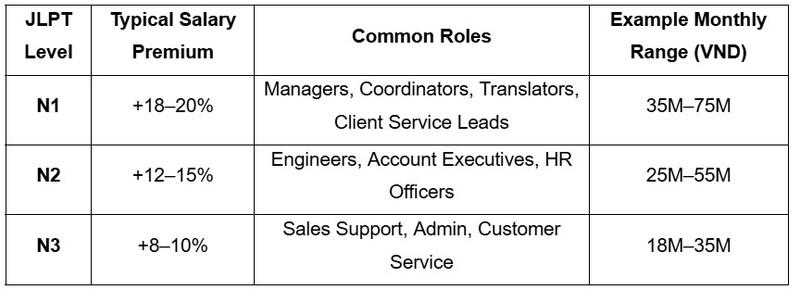
(Source: Reeracoen Vietnam Salary Guide 2025)
3. How Employers View Bilingual Talent
Bridge Between Cultures and Teams
Bilingual professionals reduce friction between Japanese management and local staff, improving project alignment and customer satisfaction.
Trusted Communicators in Sensitive Roles
Many Japanese firms prefer local employees with strong cultural understanding over external interpreters — particularly for HR, accounting, and client management roles.
Long-Term Retention and Loyalty
Studies from Reeracoen’s APAC Whitepaper show that Japanese-owned companies in Vietnam have 12% higher retention when they invest in training bilingual employees.
📘 Related Reading: [Cracking Retention in Vietnam 2026 – Onboarding Matters]
4. Future Outlook: The Bilingual Advantage Will Grow
The rise of AI-driven translation tools hasn’t reduced the value of human bilingual talent — it has increased it.
Employers now look for professionals who combine language proficiency + emotional intelligence + cross-cultural adaptability, especially in leadership roles.
As Vietnam continues to attract new Japanese investment in green energy, manufacturing, and digital services, the demand for bilingual professionals will outpace supply well into 2026.
📘 Related Reading: [Vietnam Hiring Trends 2026 – Sectors to Watch as FDI Rises]
5. Tips for Jobseekers
-
Get Certified: Aim for JLPT N2 or above — these levels significantly boost your employability.
-
Highlight Communication Skills: Japanese firms prize politeness, precision, and teamwork — make sure these traits appear in your résumé and interview answers.
-
Combine Skills: A bilingual engineer, HR executive, or finance analyst earns far more than a monolingual one.
🔍 FAQ
Q1. Is the Japanese language premium only for certain industries?
No. It applies across manufacturing, trading, IT, and consulting — any firm with Japanese investment or clients.
Q2. How much higher can a bilingual salary go?
On average, 10–20%, with exceptional JLPT N1 professionals earning up to 25% more.
Q3. Are there enough Japanese-speaking professionals in Vietnam?
Currently, fewer than 80,000 JLPT-certified professionals are in the labour market — far below demand.
Q4. How can I start learning Japanese for career growth?
Take structured JLPT preparation courses or join corporate training offered through partnerships between Reeracoen and local institutes.
👩💼 For Jobseekers: [Submit Your CV — Find bilingual roles in leading Japanese companies across Vietnam.]
💼 For Employers: [Book a Consultation — Discover how Reeracoen can help you hire and retain high-performing Japanese-speaking talent.]
✅ Final Author Credit
-
By Valerie Ong (Regional Marketing Manager, Reeracoen)
-
Published by Reeracoen Vietnam — a leading recruitment agency in APAC.
📚 References
-
Reeracoen × Rakuten Insight APAC Workforce Whitepaper 2025
-
JETRO Vietnam Business Conditions Survey 2025
-
Vietnam Ministry of Labour (MoLISA) Employment Outlook 2025
-
Japan Foundation JLPT Global Data 2025
🔗 Related Internal Articles
Related Post
 “Tôi luôn ở đây vì bạn”: Khi Reeracoen Way không chỉ còn là lời nóiGeneral
“Tôi luôn ở đây vì bạn”: Khi Reeracoen Way không chỉ còn là lời nói Tại một ngôi làng dành cho trẻ em ở Philippines, cách xa những văn phòng...
- “I’m Here for You”: When the Reeracoen Way Became More Than WordsGeneral
“I’m Here for You”: When the Reeracoen Way Became More Than Words In a children’s village in the Philippines, far from Reeracoen’s offices across...
 3 Thách thức Tuyển Dụng Nhân Sự Lớn Doanh nghiệp Việt Nam Phải Đối Mặt trong 2026General
3 Thách thức Tuyển Dụng Nhân Sự Lớn Doanh nghiệp Việt Nam Phải Đối Mặt trong 2026 KẾT QUẢ CHÍNH — Báo cáo Xu hướng và Kỳ vọng Người Lao động Việt...
- The Triple Constraint: Why Vietnam Employers Are Losing the Talent War on Three Simultaneous Fronts in 2026General
The Triple Constraint: Why Vietnam Employers Are Losing the Talent War on Three Simultaneous Fronts in 2026 KEY FINDINGS — Vietnam Worker...